
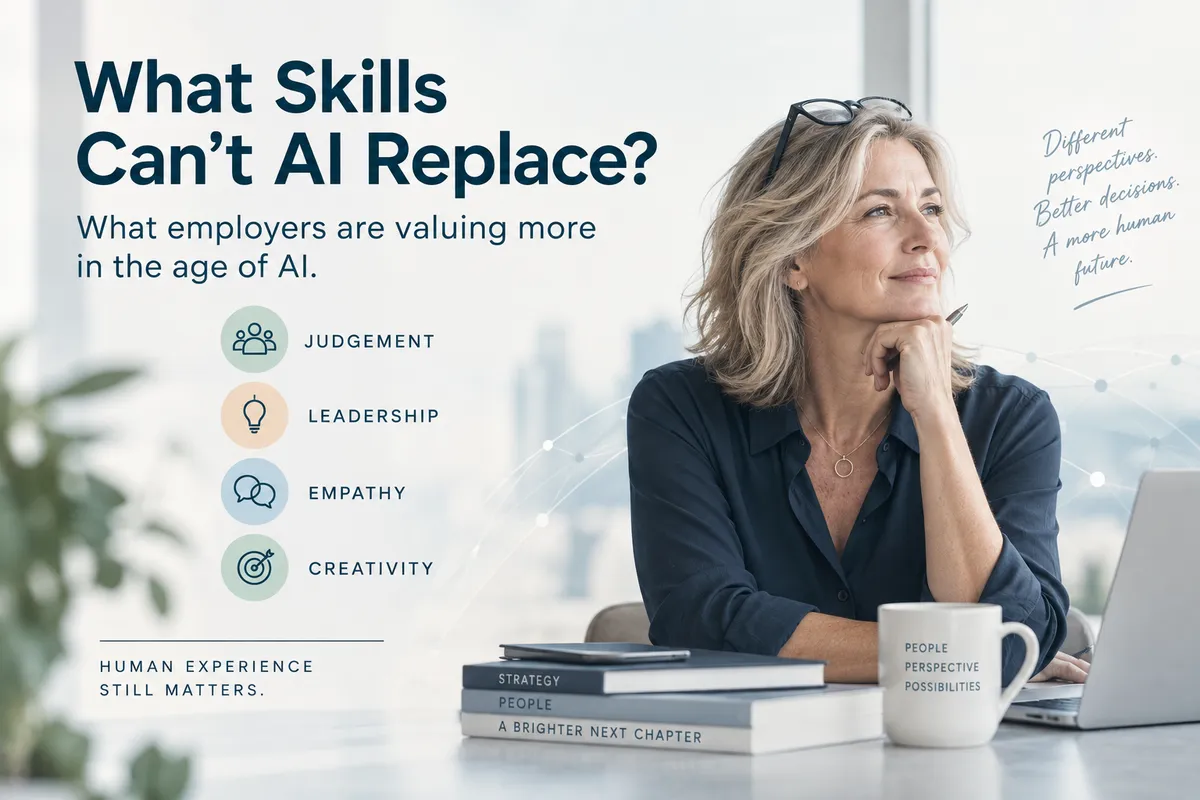
What Skills Can't AI Replace? What Employers Are Valuing More in the Age of AI
If you've spent 20 or 30 years building expertise in your field, it's understandable to wonder what happens to the value of that experience as AI becomes capable of doing more.
But perhaps “What can't AI replace?” isn't quite the right question.
A more useful one might be:
What are employers valuing more as AI becomes part of the workplace?
And we are beginning to get some interesting answers.
Experience May Matter Differently
PwC's 2026 Global AI Jobs Barometer analysed more than one billion job ads across six continents.
One finding caught my attention.
The most AI-exposed junior roles are now seven times more likely than the least AI-exposed junior roles to require traditionally senior skills such as leadership and strategic thinking.
PwC also found that new tasks being added to AI-exposed jobs are 2.5 times more likely to rely on human-intensive skills such as empathy, judgement and creativity.
That doesn't tell us that experience is protected from AI.
It tells us something more useful: the skills employers need are changing, and human judgement and expertise remain part of that change.
What Does Judgement Look Like in Practice?
“Judgement” can sound rather abstract.
After years in a profession, it may look like:
recognising which problem actually needs solving
making a decision when you don't have all the information
reading a difficult situation and knowing when to act
explaining something complicated to someone who doesn't have your expertise
knowing when to challenge an assumption
recognising when an answer looks plausible but doesn't make sense in context
These abilities are easy to overlook when you've used them for years.
They become part of how you work.
AI May Change Where Your Value Sits
PwC describes two different directions emerging in the labour market.
In some roles, AI makes complex work accessible to more people. PwC calls these “democratised” jobs.
In others, AI takes on more routine work while people concentrate on work requiring greater expertise, judgement and creativity. PwC calls these “professionalised” jobs.
Interestingly, those professionalised jobs are currently growing faster and seeing stronger wage growth.
So I wouldn't assume that AI automatically makes 20 or 30 years of experience less valuable.
But I would ask a different question about that experience:
Which parts of what I know have become more valuable because AI can now do some of the other work?
Your Expertise May Be Harder to See Than You Think
When you've done something for years, it is easy to focus on the obvious parts of your job: the reports you produce, the meetings you run, the contracts you review, the projects you manage.
Some of your most valuable experience may be less visible.
It may be how you make decisions.
How you recognise patterns.
How you deal with ambiguity.
How you communicate with different people.
How you know when something isn't quite right.
Those are worth identifying, particularly if you are beginning to think about using your experience in a different way.
Take Stock Before You Decide What Comes Next
You don't need to predict exactly what AI will be capable of five years from now.
But you can become much clearer about what years of experience have actually taught you.
Not simply what jobs you've held.
What do you know how to do because you've been doing it for a long time?
That is a useful inventory to have, whether you stay where you are, change direction, work independently or eventually build something of your own.
CTA: Once you've started identifying what you bring with you, you may need room to explore where it could fit next. Create Time Before You Decide is my free guide for creating that room before making a big career decision.