
ABOUT KAREN KRAMP
If you're here because you searched "who is Karen Kramp" — here's the honest answer, including the parts I don't always lead with
MY CAREER HAD BECOME PART OF WHO I WAS
I spent almost ten years in one company and eventually became a Vice President. I knew the organisation, the people, the language and the way things worked.
And somewhere along the way, my career had become more than what I did. It had become part of who I was. So when I first began to feel that I wanted something different, imagining another life wasn't easy. I wasn't simply considering leaving a job. I was questioning a working life I had spent decades building.
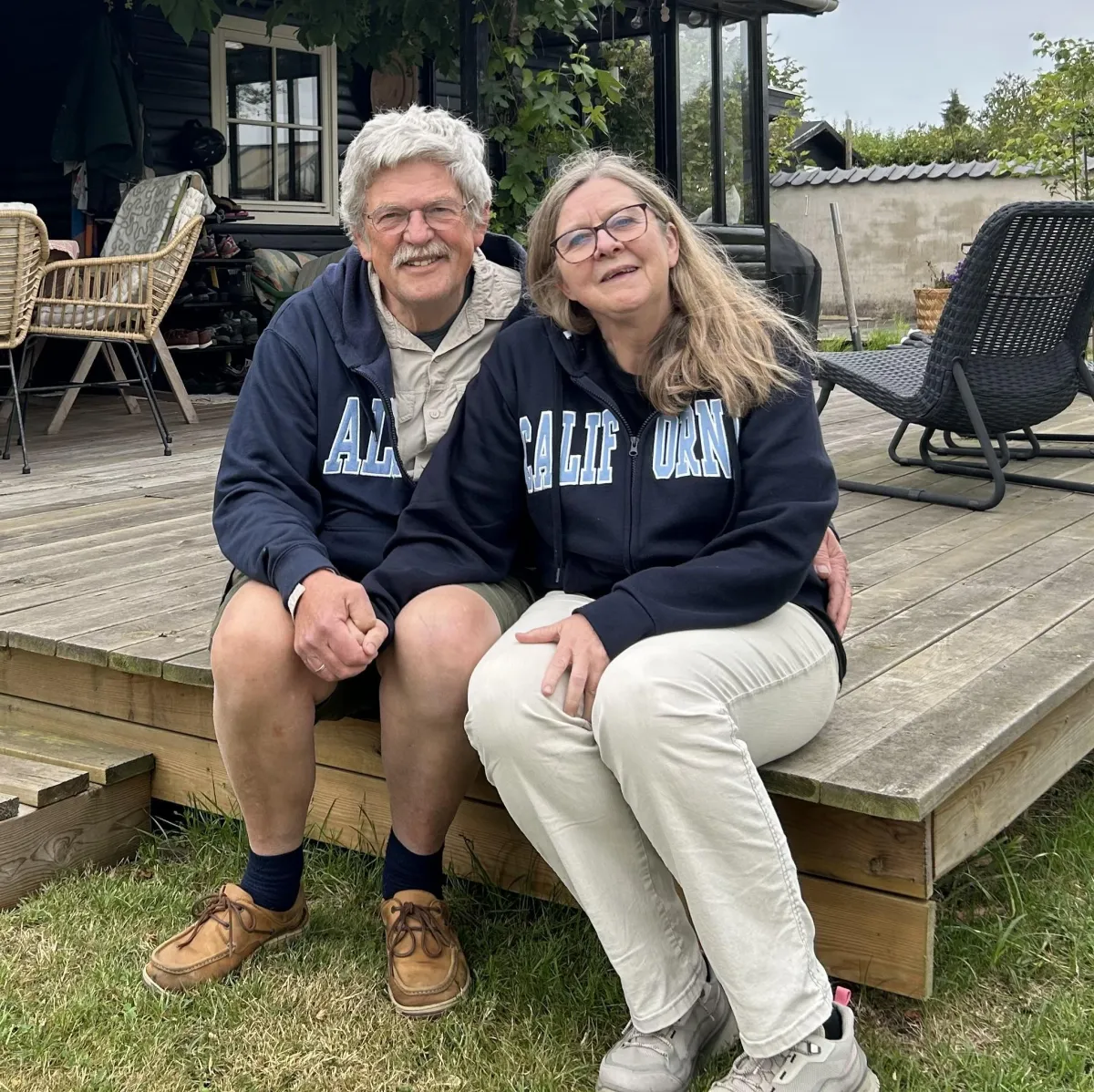
And there was another question becoming harder to ignore: what did I want my time for? That involved my husband, Steffen.
WHAT DID WE WANT MORE TIME FOR?
As Steffen and I started talking seriously about the future, we discovered we were thinking about many of the same things. We wanted more time together. More time with our son, family and friends. More room for the things that mattered to us outside work.
For years, career progression had been an important part of how we both measured success.
Gradually, other things became more important.
I didn't want to stop working or contributing — I still wanted interesting work and to use everything I had learned. I just didn't want work to take up so much space that there wasn't enough left for the rest of my life.
WE NEEDED TO KNOW WHAT WAS POSSIBLE
Before making any big decisions, Steffen and I needed to understand what changing our working lives would mean financially. We looked at our income, spending, savings and pensions. I built different scenarios for our future, and we met with our financial adviser.
We also looked at our spending — what did we really value, and what could we easily live without? I decided to cut down on consumption that wasn´t important. It turned out to be a fun challenge. Still today I wonder why we buy all the stuff we don´t need.
Every expense we could comfortably live without reduced the amount of income we needed — and that gave us more freedom and flexibility.
By putting the numbers on the table, we could see what was realistic, and what choices we actually had.
WE CHANGED THE WAY WE WORKED
Within six months, both of us had made significant changes. Steffen negotiated a four-day working week. I resigned from my VP role, took three months off, and then started a new job in a different industry.
It was a smaller job with less responsibility — exactly what I was looking for. I still had interesting work, but more room for the rest of my life. Over time, the job became part-time, which gave me something I hadn't expected: space to explore.
I started learning new things and looking at possibilities outside the traditional career path I had known for so long.
Eventually, that led me into the online world — with no background in digital business, working out how decades of experience could translate into a completely different environment. I began to see there were more possibilities open to me than I had thought.
If any of this sounds familiar — the sense that success needs redefining, or that quiet question of what you actually want your time for — you're not on unfamiliar ground.
I KNEW SOMETHING ABOUT CHANGE
Change itself wasn't new territory for me. During my corporate career, I had been directly involved in major organisational changes.
I used my knowledge about the Kübler-Ross Change Curve to remind people who needed it to understand where they were in the process of adjusting to disruption — and Stephen Covey's Circle of Influence to remind us all to direct our energy toward what we could actually control, rather than everything we couldn't.
I had seen first-hand how differently people respond when something familiar is disrupted. Some adjust quickly. Others stay stuck for a long time. That is completely normal.
If you are curious about this, download the Pivot Map in my bio.
Going through my own career change gave me another perspective entirely. I knew from experience that understanding where you are matters, and so does being realistic about what you can and cannot influence.
But knowing those things doesn't mean you suddenly have all the answers. I still had to work out what I wanted, what was possible, and what I was willing to change — one step at a time.
WHY I SHARE THIS
There are many ways to change direction in the middle or later part of a career. I simply work with the path I took. I share what I learned.
I was fortunate in many ways. My husband supported me, and somehow we started the exploration journey together.
But having choices and making them are two different things. Leaving a senior position that had become part of my identity took determination. So did choosing a smaller job, changing industry, and later, becoming a beginner again in the online world.
I hope to inspire you
Along the way, I've written down much of what I learned and created resources around the things that helped me most: making room to think, understanding what matters now, exploring possibilities, and looking carefully at risk before making big decisions.
I share them here for experienced professionals who may recognise something of their own situation in mine. You don't have to follow my path. But perhaps something I learned along the way can help you find yours.
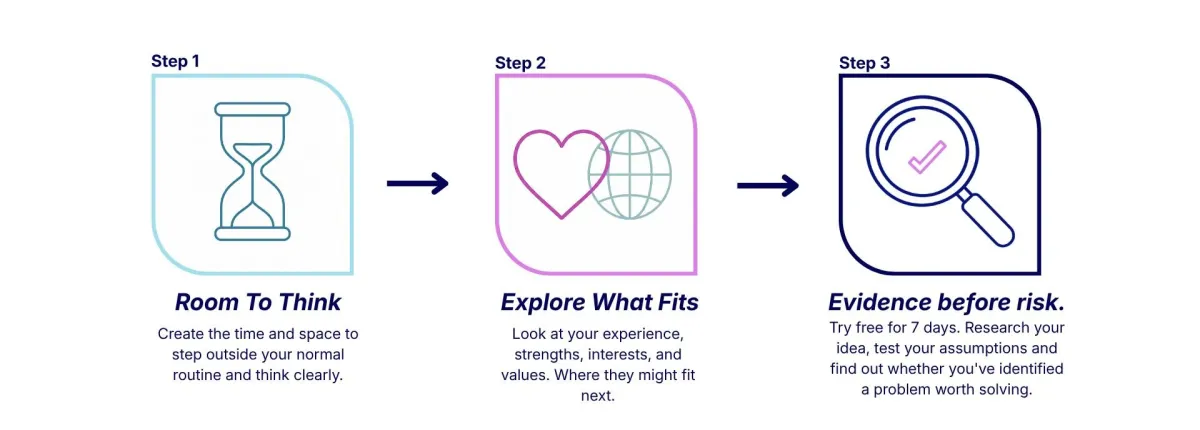
This is the 3-step model I used. It allowed me to explore the online space at my own pace. I had no technical or marketing experience. So, I had a lot to learn. It was never an online business from day one. But the journey was and still is fantastic.
YOU MAY BE WONDERING...
What do you actually offer?
Three resources, based on the path I took myself:
1. Creating time to think. Free workbook.
2. Finding where your experience meets real demand. $27 workbook
3. If you want it — learning to build online through the platform I have been a member of for 5 years. There´s a free 7-day trial.
I trust the platform 100%. I know what they offer; I use their products and systems myself. Look in my BIO; This where you start.
Why start with time?
Because it's hard to see a different future when your current life takes all your attention. Time gave me room to think, learn and explore before I gave up a secure income. It's part of reducing risk. If you have the time you ned to move forward go to the next step.
Why "Heart Meets Market"?
Because both matter. I assume you want your next chapter to feel meaningful — but if you also want to earn from it, someone must need what you offer. Heart Meets Market is about finding where the two overlap.

Why do you recommend a specific education platform?
This is all about trust. It can be so difficult to find a platform you can trust that delivers value for money. I have been a member for more than 5 years; I know the team, the leadership and the values they represent.
It's the platform that taught me how to turn real experience into something the online market values. I'm an affiliate, so I may earn a commission if you join through my link.
Who is this for?
People with real experience wondering how to use it differently — consultants, coaches, advisers, leaders. You don't need the answer yet. Just the curiosity.
Why the online world?
It's opened up markets that used to be expensive to reach. One person can publish, build a brand, or test an idea without a big upfront investment. Start small. See if it has legs.
Is this another "make money online" promise?
No. I believe in real opportunity — but turning experience into something valuable takes time, testing and trust. I'm interested in evidence before risk, not overnight claims.
Isn't AI making experience less valuable?
The evidence says the opposite. PwC's 2026 Global AI Jobs Barometer found AI-exposed entry-level roles now demand senior-level skills seven times more often. The World Economic Forum still ranks analytical thinking as the top skill employers want. AI produces information fast — experience tells you what to do with it.
Does any of this cost money?
Yes, some of it. The workbooks and resources all have a clear label. You'll always know what you're paying for before you pay. The platform I recommend has a full offering from beginner to expert on their own platform
Will I end up on a list that emails me constantly?
No. You'll hear from me when I have something worth saying — not on a schedule designed to sell you something.
Do I need to already know what I want to build?
No. Most people who start here don't. That's the point of the path — it helps you find out, not assume you already have.
Is this actually you, or a team?
It's me. I read what comes in and I write what goes out. If you reply to an email, I'm the one reading it.
How much time does this actually take?
You do need to protect some time. In the beginning, when you explore, it´s just a few hours a week.
What happens after that depends on your results, what your goals are and if you like to build and develop online. I didn´t know if it was for me until I understood more of what it requires on da aily basis.
My Mission & Who I Serve
I walked away from a career at its peak — a VP role, real status, everything that was supposed to matter. Then I had to learn what actually did.
Now I help resourceful professionals in midlife ask that same question, before life forces it on them. Your experience isn't behind you. It's what you build the next chapter with.

Copyrights 2026 | Karen Kramp™