

How to Know What to Do Next in Your Career
How to Know What to Do Next in Your Career
You know you want something different.
The difficult part is knowing what.
A different job? A new industry? Fewer hours? Consulting? Something of your own? Or perhaps staying where you are for now while you explore?
When you've spent 20 or 30 years building a career, the number of possibilities can make the question harder rather than easier.
I don't think you need to find one perfect answer.
You need a way to start narrowing the possibilities.

Start With What You Already Have
When people think about changing direction, they often start by looking at jobs.
I would start somewhere else.
Look at what you've accumulated over your working life.
Your expertise, of course. But also the problems you know how to solve, the situations you've learned to handle, the people you understand, the judgement you've developed and the things other people regularly come to you for.
Some of these may feel completely ordinary to you because you've been doing them for years.
They aren't necessarily ordinary outside the world you've been working in.
Before asking What new career should I choose?, ask:
What am I already carrying with me that could be useful somewhere else?
Then Look at What Fits You Now
Experience is only one part of the picture.
You may also have changed.
Perhaps you want more autonomy now. More time. More meaningful work. Less responsibility. More responsibility of a different kind. Perhaps you want to contribute in a way your current role doesn't allow.
And there may be things you've become curious about that you haven't had much opportunity to explore.
This is where interests, strengths and values matter.
They don't automatically reveal your next career.
But they can help you recognise directions worth investigating.
Look Outward as Well as Inward
This is the part I think is often missing from conversations about purpose.
You can spend months thinking about what you love, what you're good at and what gives you energy.
But if you want your next direction to provide an income, eventually you also have to look outward.
Where might what you have be useful?
Which industries are changing?
What problems are people or organisations trying to solve?
Who might value the experience you already have?
Could your expertise work in another industry, another type of role, consulting, teaching, advising or something you build yourself?
You don't have to know the answer yet.
You're looking for possibilities where what fits you and what the world needs begin to meet.
Create Enough Room to Explore
Of course, exploration requires something many experienced professionals don't have much of:
time.
If your current job consumes most of your attention, it can be difficult to investigate anything properly.
This was an important part of my own transition.
I didn't move directly from being a Vice President into what I do today. I took a smaller job in another industry. Later, I worked part-time.
That gave me room to explore.
Your version might look completely different. Perhaps you can protect a few hours each week. Perhaps you can reduce your expenses and eventually work fewer hours. Perhaps your current job gives you enough flexibility already.
The point is simply to create enough space to investigate rather than forcing yourself to decide.
Test Possibilities Before You Commit to Them
Once something begins to interest you, you don't have to immediately turn it into your new career.
Find out more.
Talk to someone doing it.
Take a course.
Try a small project.
Offer your expertise in a different context.
If you're interested in building something of your own, test whether anybody actually wants what you're considering offering.
You may discover that an idea has potential.
You may discover that you don't enjoy it nearly as much as you expected.
Both are useful information.
You Don't Need the Whole Answer
When I began changing my own working life, I couldn't have predicted where I would eventually end up.
Some possibilities only became visible after I had created enough room to explore them.
That's why I don't think the first task is to identify your perfect next career.
A more manageable sequence is:
Understand what you have.
Notice what fits you now.
Look for where it could be useful.
Then test what interests you.
You don't need certainty before you begin.
You need enough information to decide what is worth exploring next.
Create Time Before You Decide
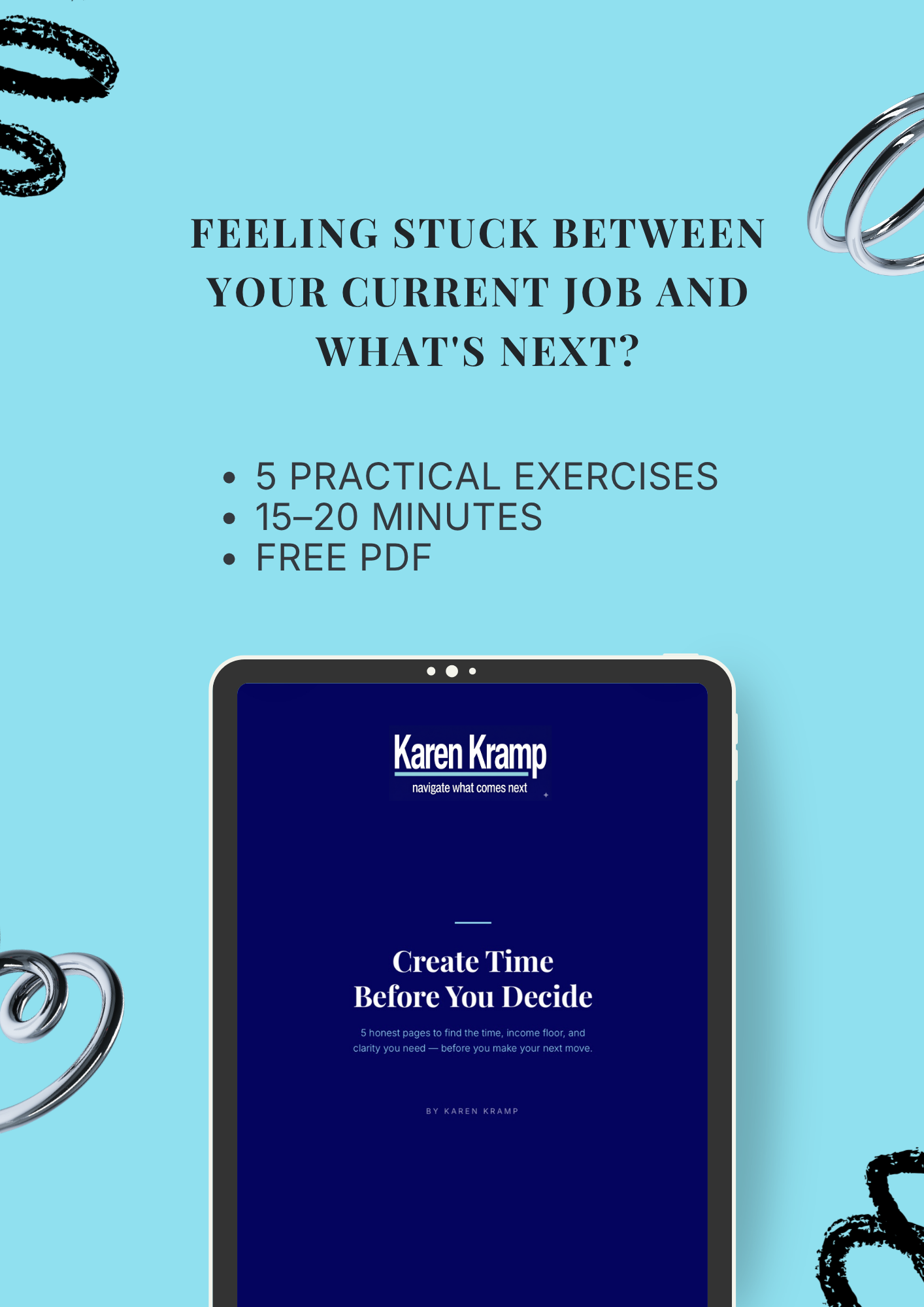
If you know something needs to change but don't yet have enough room to explore what comes next, Create Time Before You Decide helps you look at your time, finances and practical options before making a big career decision.